
From February to November 2026, we are developing the Strategy to promote the main socio-biodiversity clusters in the Legal Amazon.
This project is implemented by Sudam and funded by UNDP, and falls within component 3 of project BRA/21/005, which seeks to strengthen and empower Sudam with knowledge, tools, and methodologies that enhance its capacity for implementing, monitoring, and evaluating its short-, medium-, and long-term strategic plans aimed at the sustainable growth of the region, thus contributing to the achievement of the Sustainable Development Goals in Brazil.

The project is implemented by a consortium of three national companies specializing in clusters, regional development, and the Legal Amazon region.
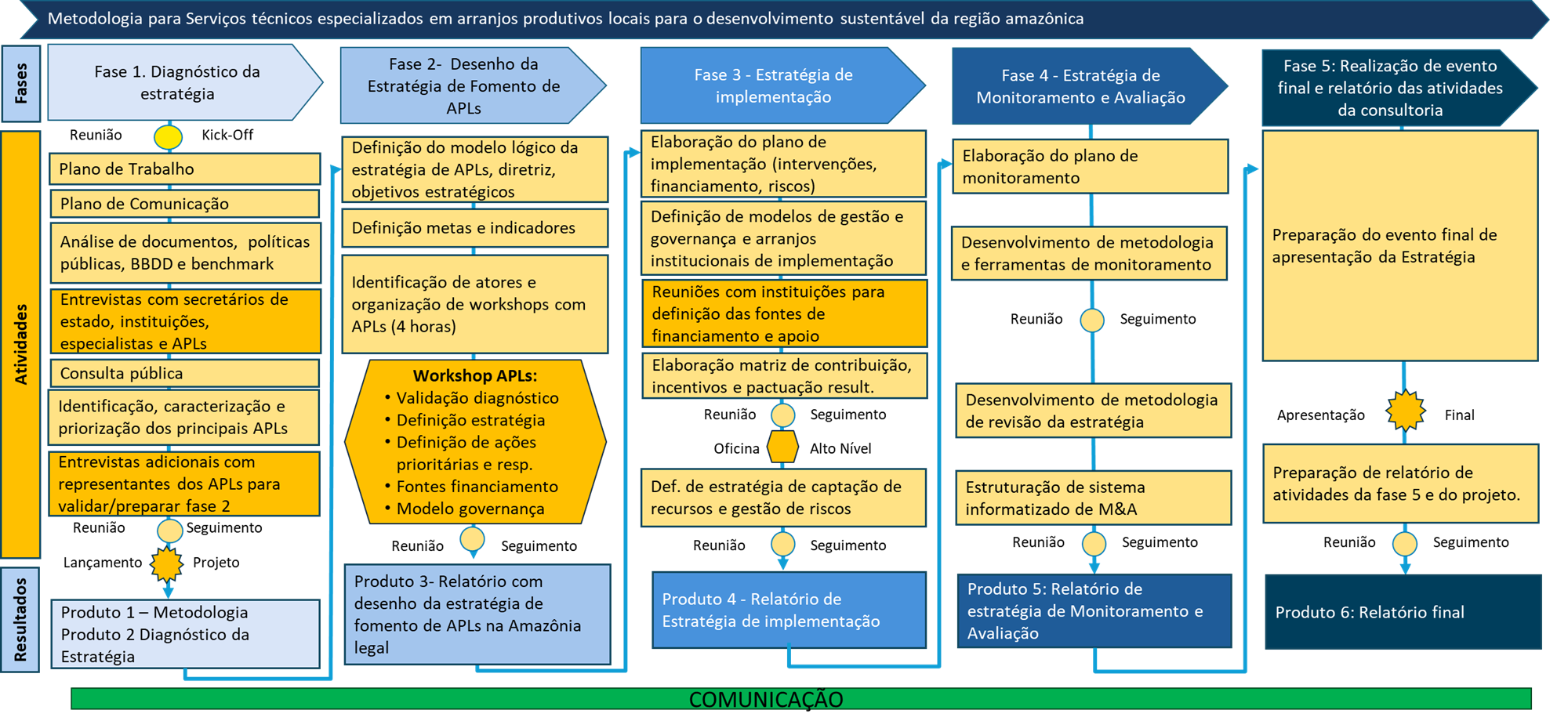
The project aims to develop a strategy for promoting socio-biodiversity clusters in the Legal Amazon, and is divided into five phases:
- Initial diagnosis that serves as the basis for strategy development.
- Design of the cluster development strategy.
- Construction of the implementation strategy.
- Monitoring and evaluation plan.
- Final presentation of the strategy.
Below is a summary of the methodology:
This project will be completed in 9 months. The detailed week-by-week work schedule is presented below.
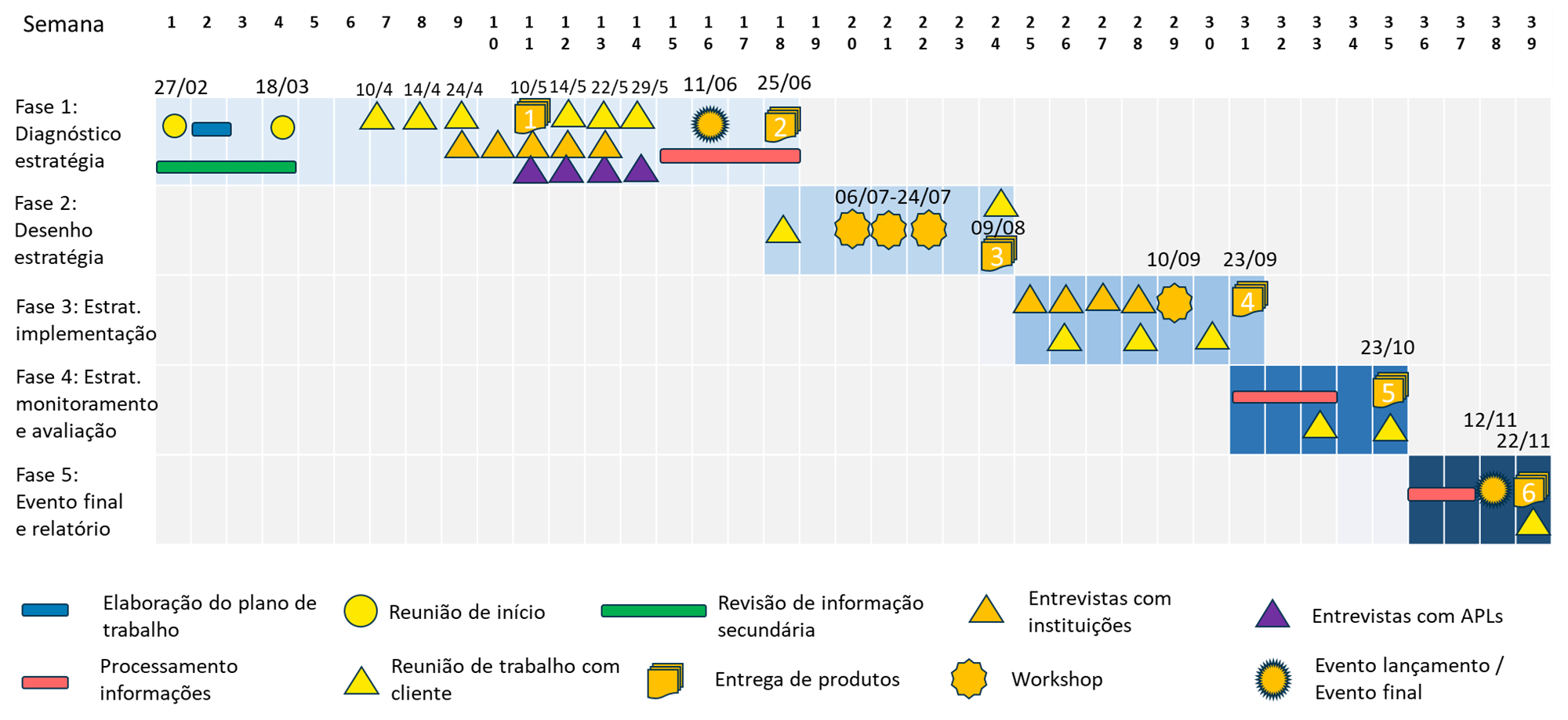
Currently, in the week of May 25, 2026, week 14 of the project, the consulting team has already identified the main bottlenecks for the development of the clusters, as well as the most relevant clusters according to the reviewed documentation, quantitative analysis, and interviews conducted. At this time, it is opportune to conduct a public consultation to receive comments on the analysis of the bottlenecks and the clusters.
A cluster is a concentration in a territory of economic agents (companies, cooperatives, associations, producers), political and social agents, including support institutions, that are in the same business (productive activity in the broad sense), that have significant links of interaction, cooperation and local governance, and that have common challenges of competitiveness and sustainability, which encourages them to collaborate to overcome these challenges more effectively (better results) and efficiently (better return on investments made).
In general, socio-biodiversity is associated with the interaction between biodiversity, territorial production systems and ways of life of traditional peoples and communities, constituting a strategic basis for sustainable development policies. Thus, sociobiodiversity can be understood as: The set of resources, products, knowledge, and productive practices associated with the biodiversity of Brazilian biomes and the lifestyles of indigenous peoples, traditional communities, and family farmers, whose sustainable use structures production chains, promotes productive inclusion, contributes to environmental conservation, and constitutes a strategic basis for territorial and regional development.
Clusters are similar but not equivalent to the Sociobioeconomy Development Centers (SDC), which are collaborative territorial structures supported by the National Sociobioeconomy Program (Prospera) of the Ministry of the Environment, focused on integrating local communities, sustainable production chains (such as açaí, Brazil nuts, oils), and access to markets. They act as regional hubs to strengthen impact businesses, environmental conservation, and social development.
The main differences between a cluster and a SDC are that a cluster is focused on a sustainable business that already has economic relevance and governance, and therefore has already passed through the initial stages of capacity building and productive organization. It is now at a point of sophistication in its market positioning strategy, value aggregation, innovation, improving environmental impact, and generally reaching a new level, which requires building new competencies.
The development of initiatives to strengthen clusters is a widely applied public policy in Europe and other countries. In Brazil, currently, the best example of a cluster promotion strategy is the National Integration Routes of the Ministry of Integration and Regional Development (MIDR), which supports approximately 79 clusters organized into 12 productive routes, 11 of which are located in the Legal Amazon region.
Sudam (Superintendency for the Development of the Amazon) identified the need and potential to promote a new strategy with the support of UNDP and regional partners.
The new strategy for promoting socio-biodiversity clusters in the Legal Amazon will define which clusters will participate and how to strengthen them, but some critical points already identified are:
-
Participating clusters must be socio-biodiversity-based, have significant economic relevance in terms of production or producers, have a positive environmental and social impact, and possess structured social capital or governance with strategic decision-making bodies.
-
The work will focus on defining a long-term strategic vision, improving governance, having professional management, and defining and supporting high-impact projects for the cluster.
You can access the public consultation on the Sudam website.
On June 11, 2026, the project will be launched to explain its objectives and activities. It will take place at Sudam headquarters in Belém, Pará, and will be broadcast online. We will be releasing details soon.
More information about the project will be available soon.
Brazil